
By Theodoros Konstantinou, Postdoctoral Research Fellow, Energy Environment and Water Research Centre, The Cyprus Institute
The launch of the competitive electricity market marks a major milestone in Cyprus’s energy transition. Until recently, electricity generation and supply were dominated by a single vertically integrated company, the Electricity Authority of Cyprus (EAC). This arrangement, while effective in earlier stages of system development, limited consumer choice and competition. The establishment of an organised electricity market represents a structural reform aligning Cyprus with the European Union’s internal energy market principles, as set out in the EU Target Model.
From monopoly to market operation
Under the new framework, electricity is no longer traded through a single-buyer model but through a structured, rules-based market operated by the Cyprus Transmission System Operator (TSOC). Producers, suppliers, and aggregators can now submit their offers and bids on a daily basis through the Market Management System, which determines the market-clearing price and schedules generation accordingly. The system is designed to enhance transparency, efficiency, and competitiveness in how electricity is produced, sold, and consumed.
The Cyprus Energy Regulatory Authority (CERA) retains oversight of the market, ensuring that it operates in a fair, efficient, and EU-compliant manner. The new framework also introduces the roles of Balancing Responsible Parties (BRPs) and Balancing Service Providers (BSPs), making each participant responsible for deviations between its scheduled and actual generation and enabling them to provide balancing and ancillary services, respectively.
Market structure and operation
The Cypriot market follows the structure of the EU Target Model, which separates trading into distinct timeframes:
Each stage of the market contributes progressively to meeting the system’s demand profile, as shown in the graphs below: the Forward Market covers a large share of demand through long-term contracts, the Day-Ahead Market adjusts generation schedules closer to delivery, the Intra-Day Market fine-tunes positions based on updated forecasts, and the Balancing Market corrects any remaining deviations in real time to ensure that generation matches actual load.
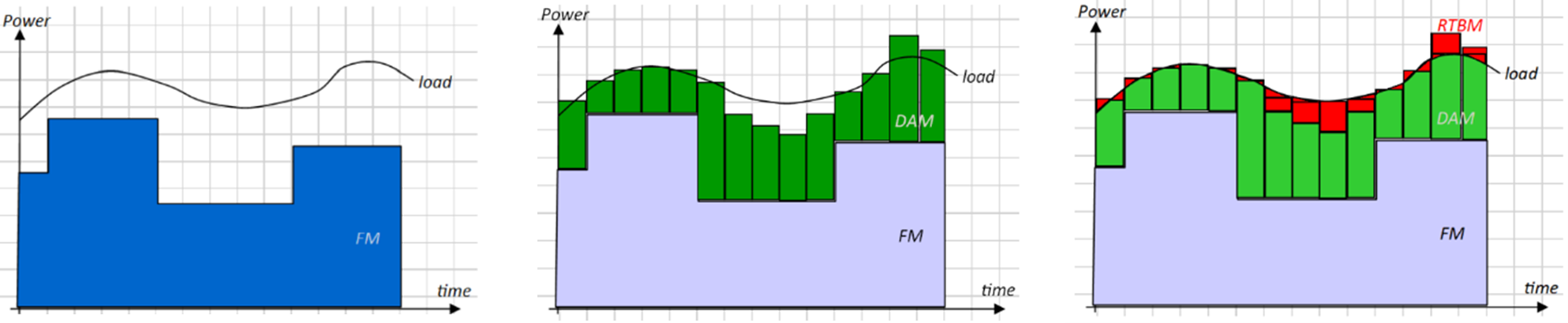
Source: Cyprus Transmission System Operator (TSOC), Αγορά Ηλεκτρισμού – Ενημερωτική Παρουσίαση Ενδιαφερομένων αρ.1–3, 2021 (V12).
Participation and transparency
A wide range of participants can now take part in the market. Conventional power plants, renewable energy producers, storage operators, and aggregators are all eligible to participate under defined market rules. The introduction of RES aggregators is particularly important, as it allows small and distributed renewable installations to be represented collectively, facilitating their participation without each operator having to engage directly in market operations.
For consumers, the launch of the market lays the groundwork for a more dynamic electricity sector. While consumers initially remain with their existing suppliers, the framework enables new retail companies to enter the market and offer alternative supply contracts. Over time, this is expected to encourage innovation in pricing schemes, demand response, and customer services.
A non-interconnected market
Unlike most European countries, Cyprus remains a non-interconnected system — meaning its electricity network is not physically connected to neighbouring grids. This isolation presents both operational challenges and economic implications. Without the ability to import or export electricity, supply and demand must always be balanced locally, often resulting in higher price volatility compared to interconnected systems.
The lack of interconnections also limits the ability to share reserves or rely on imports during shortages, placing greater importance on domestic flexibility resources such as energy storage and demand-side management. As a result, market participants in Cyprus operate under tighter technical and economic conditions, and system security depends heavily on accurate forecasting and efficient scheduling by the TSO and Market Operator.
Implications for the energy transition
The launch of the electricity market represents a fundamental step toward integrating higher shares of renewable energy. By introducing competitive price signals, it encourages more efficient operation of power plants and supports the gradual shift from fossil fuels to clean energy sources. It also establishes the framework necessary for future innovations — such as the participation of energy storage systems, demand response, and aggregators that can combine distributed resources to provide balancing services.
Although Cyprus’s market will initially operate independently, its design follows the same principles as the EU Target Model, ensuring future compatibility with regional markets. The market opening therefore not only introduces competition domestically but also prepares the system for eventual interconnection and deeper integration into the European electricity network.